Tuesday, March 5, 2013

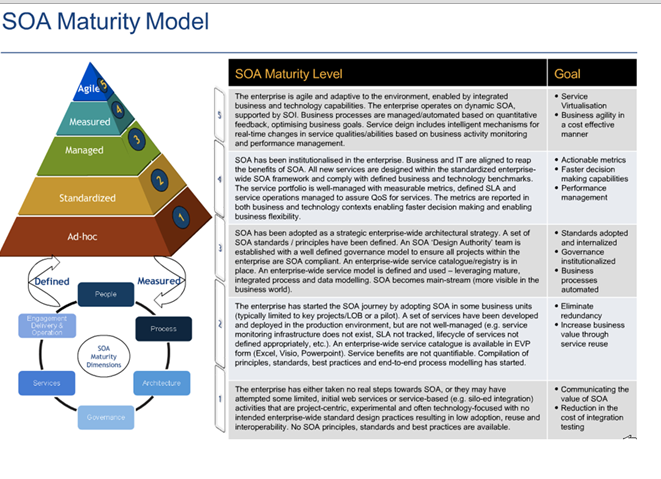
SOA Maturity Model?


Why we need SOA Maturity Model?

SOA maturity model basically serves for following purpose

1.Descriptive purpose-where companies are with respect to othrs in industry so they are talking in same  language
2.Roadmap--they are able to set priorties

To be clear about the gaps to meet business requirements and individualize based on business goals and to be able to put effort in terms of work,resources,budget,enable business to meet goals.

Framework which we put around SOA how project is funded,data ownership/data standards,how portfolios are built,operations are carried,architecture,technology foundation,project are funded,people built.We can use the same framework to define policies/governance framework that we need to make SOA successfull,we can defined goal for future,understanding risks and mitigating against it.

Signifance of 8 dimensions in SOA maturity model

->The 3 SOA strategies

->Project driven--you apply SOA tools/techniques project based betn depts.foundation to be built on SOA capabiliies
->Service/consolidation driven--SOA is means to consolidate the duplicate capabilities betn different systems betn diff depts
->Process driven-Companies automate business processes and use SOA as foundation for the automation of processes.

Based on maturity you can decide any of three strategies

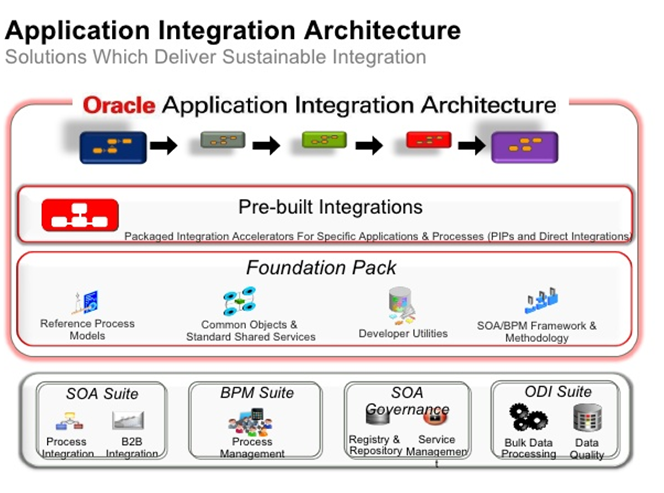
Oracle AIA PIPS Vs Oracle SOA

Oracle AIA PIPS
Oracle SOA
1.It is Built on SOA framework and leverages features of SOA.
1.It is an underlying layer of AIA
2.PIPS are pre-built by oracle
2.SOA interfaces are not pre-built.They need to be architected based on company’s governance and maturity to adopt SOA.
3. lots of customization/extensions makes it complicated/ambiguous
3.More flexible configurability with less customization
4.Lack of good logging/reporting capabilities
4.Good logging/reporting capabilities
5.Modularaity not much supported
5. Provides support to Open SLA standards and providing modular approach.
6.Reduced development time and high reusability but there was risk of inconsistent data for development  & maintenance
6. Reduced development time and high reusability
7.There was risks involved to evolve and maintain
7.Integrations that easy to maintain and less risky to evolve
8.Interoperability issues
8.No interoperability issues due to canonical data model approach
9.TCO is more compared to SOA TCO
9.Less TCO
10.Deployment involves risks and has bottlenecks
10.Speed Deployment by reusing components (service reuse)
11.Higher on going cost of maintenance and support costs
11.Lower ongoing cost of maintenance and support costs
12.Less agile across businesses
12.Increased business agility
13.ROI is less,however coupled with risks,errors and higher maintenance cost
13.Less ROI with speed deployment and less maintenance cost


Monday, September 24, 2012

Steps To ensure WF_DEFERRED AGENT LISTENER to be UP and RUNNING on Target Instance!


Use the following steps to ensure that the WF_Deferred Agent Listener is running on the target database.

1.      Log in to Oracle Applications with the System Administrator responsibility.
2.      On the Oracle Applications home page, select the Workflow Administrator Web Applications responsibility. Select Oracle Applications Manager > Workflow Manager from the menu.
3.      On the Applications Manager page, click the Agent Listeners icon. The Service Components page appears, containing a list of the installed agent listeners.
4.      In case if Agent Listener is down which could be because any service component failing and giving status “STOPPED WITH ERROR”, check for Workflow Agent Listener Service
5.      Workflow Agent Listener Service contains the service instances which are Workflow Mailer Service, Workflow Document Web Services Service, Workflow Agent Listener Service in either deactivated, verifying or aborted status.Restart ALL to activate them.
6.      In case a message that "Internal manager is down" is shown on restarting these instances ,check for the Internal Manager configuration .Login as sysadmin goto System Administrator>Concurrent:Manager>Administer. For the Internal Manager to be up and running,ACTUAL COLUMN must not be 0.
7.      If Actual column is 0 then Concurrent Manager is not running
8.      Ideally Concurrent Manger needs to be restarted and reconfigured so do the following:
         1.Shutdown the Concurrent Manager
    Goto the folder containing adcmct.cmd(windows)  or adcmct.sh script(on linux)

$Oracle_home\install\EBS\12i\inst\apps\VIS_xyz-ora\admin\scripts>adcmctl stop apps/apps
->We can manually kill processes FNDLIBR.EXE
->It can be stopped using CONSCUB utility as well
CONCSUB apps/apps SYSADMIN 'System Administrator' SYSADMIN WAIT=Y CONCURRENT FND FNDSM START=<start time> Y 0 0
9.      GOTO Services.msc and Enable the appropriate service OracleConcMgrVIS_xyz-ora.

MEDIATOR Vs BPEL Vs OSB


Differences
MEDIATOR/ESB
BPEL
OSB
Routing & mediation
Process Orchestration
Service virtualization
Used with SOA suite
Used with SOA Suite
Can be independently used without SOA suite
Development through jdeveloper IDE
Development through Eclipse IDE or Web console
Stateless Messaging
Primarily for stateful and long running processes
Stateless messaging.It can b synchronous/asynchronous.
Intra-composite mediation to connect components within a given composite


Inter-composite mediation, that is to say that it connects different
composites together and while doing that it even does service virtualization, protocol translation, service pooling,message throttling
Not present
Instance Monitoring present
Not present
Value Mapping and cross reference tables for supporting canonical datamodels
Integration of Rules Engine and Human Workflow
Value Mapping and cross reference tables for supporting canonical datamodels
Implementation of VETRO pattern
->Validate
->Enrich
->Transform
->Route
->Operate
Implementation of composite services
Includes VETRO pattern apart from extended functionality for enterprise-wide integration like
->Message throttling
->Service Pooling
->Reliable Messaging
->Split-Join
Message Transformation with XSLT
Message Transformation over Xquery and with XSLT
Can be used and deployed as a SCA component
OSB specific deployment. Not yet integrated with SCA

SIMILARITIES
1.All of them provide XA Support
2.Message Filter and Message Validation
3.Asynchronous Messaging
4.Message Transformation using XSLT
5.Have Adapter framework
6.Message Routing

SCA?


·         Service component architecture.It must be
                        ->Language neutral
                        ->Component model
                        ->Assembly model
·         http://www.OSOA.org (http://www.oasis-opencsa.org/)

SCA Terminology
Composite :Deployment Unit
Service :Entry-point into composite
Component: Provides Logic
Reference:  refers to external services
Wire :connects services, components and references

Integration Challenges


A lasting integration solution should address the top integration challenges and offer
• Better compatibility between applications
• Agility i.e the ability to adapt—the essential attitude to embrace change
• Integrated business processes that give you visibility into information across multiple systems
• Integrations that are easy to maintain and less risky to evolve, and that doesn’t break with upgrades
• Support for open industry standards, along with product functionality, operational (administration) effort, and maturity
• More-flexible configurability with less customization
• Lower ongoing maintenance and support costs
• Speed deployment by reusing components
• More responsiveness & faster service

Organizations adopting SOA will typically carry out frequent changes in response to business requirements. These changes can consist of reorganizing business processes, assembling new applications from existing business services or rewiring existing business services or applications, changing the logic of (potentially heavily reused) elementary services